Tag: legislation
What Counts as AI‑Generated?
Posted by bsstahl on 2026-03-28 and Filed Under: tools
I still have the first camera I ever used - a 126 box camera, similar to a Hawekeye II, that was basically a toy even in its own era. I shot with black‑and‑white film because that's what a kid could afford, and it produced the kind of photos you'd expect from a plastic lens and a shutter that felt like it was powered by hope. One of those photos captured Thurman Munson, the Yankees catcher who would later die in a plane crash, making him something of a larger-than-life figure in my experience. It's not a great photo. It's grainy, off‑center, and full of the accidental foreground clutter you get when you're small, excited, and holding a camera that doesn't care about your artistic intent.
Recently, I ended up with three versions of that same moment:
- The original - a scan of the actual frame I shot as a kid.
- A cleaned‑up version - run through an AI tool that removed some shadows, centered Munson, and erased the stray arms of the people next to me.
- A colorized version - also AI‑assisted, adding color to a scene that never existed in color on film.
All three images are real in the sense that they correspond to something that actually happened, and all three are altered in the sense that every photograph is shaped by the tools available at the time. When I show any version of these images, I could be asked, Is it "AI‑generated"?
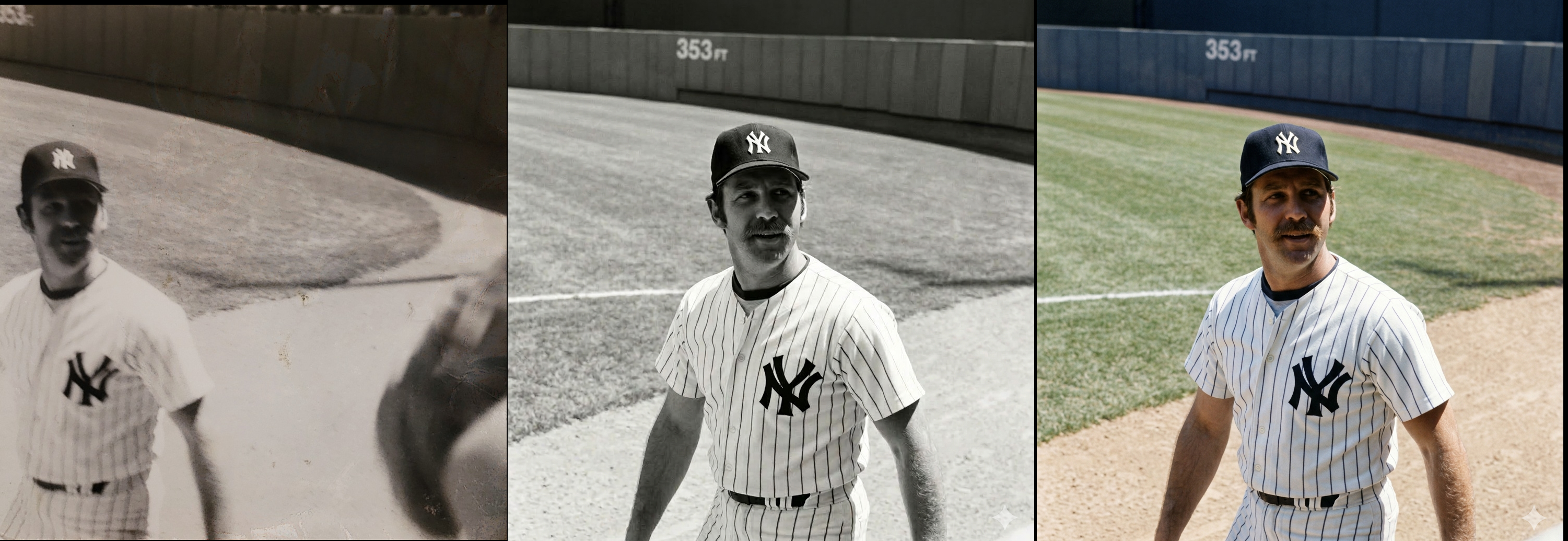
Unfortunately, that question really can't be answered without a lot more context. All 3 images used AI as part of the pipeline in some form or another, because depending on how you define AI, even the act of scanning the original likely used a model. The question we really need to answer is: what do we mean when we say something is "AI‑generated"?
The cleaned‑up version of this photo didn't invent anything. It didn't fabricate Munson's face or change the moment. It just did what darkroom techniques, Photoshop, and restoration tools have always done. The colorized version added something new, but colorization has existed for more than a century. The only difference is that a machine did the brushwork instead of a human. What about the original? It's still the moment I captured as a kid with a box camera. The digital version may have passed through modern software on its way to the screen, but the instant in time remains intact.
Even "true" photos can mislead, with or without AI
This is where things get tricky. Any still or moving image can create false impressions with the viewer. Strange lighting, unusual shadows, a frozen instant in time that doesn't really capture the essence of the situation. All of these things happen, and we've experienced them. How many times have you taken a photo of someone who was happy, but looked sad or angry in the shot? Was the dress blue or gold?
In my three images above, the event happened nearly entirely as presented in those photos. Despite that, any of these versions can still create false impressions in the mind of the viewer.
For example:
- It is possible that Munson is talking to someone, or perhaps yelling at them in a way not captured by this frame.
- When I took the picture, there may have been one or more other people just outside the frame, changing the context.
- The cleaned‑up version might imply the scene was less crowded than it really was, because the tool removed the arms of the people next to me.
- The colorized version might imply the grass at Yankee Stadium looked a certain way that day, when the original didn't capture that detail.
- The colorization might suggest Munson wore an undershirt of a particular shade, a detail the model had to invent.
None of these facts are necessarily germane to the image, but they absolutely can alter its interpretation. Still images can present scenes in a framing that doesn't completely do it justice, while AI can introduce confident, plausible details that were never in evidence, whether done maliciously or not.
This is why labeling matters. Not because AI involvement is inherently bad, but because, in most cases, viewers deserve to know which parts of an image are grounded in reality and which parts were reconstructed, inferred, or imagined. However, defining those rules is an area where a poor definition could let some people get away with anything while the rest of us end up having to tag everything as AI generated, turning the label into just more noise.
This isn't even touching the copyright issues
Everything above is about truth: what happened, what didn't, and what an image implies, but there's a whole separate dimension we haven't entered: copyright.
Questions like:
- What training data was used to create the model?
- Who owns the derivative works?
- When does enhancement become transformation?
- What rights do I retain over my own childhood photo once an AI model has touched it?
These aren't footnotes. They're large, unresolved questions that deserve their own analysis and probably their own regulatory framework. Mixing them into the "AI‑generated vs. not" debate only makes everything muddier. So for this post, I'm deliberately setting copyright aside; not because it's unimportant, but because it's too important to treat as a parenthetical.
The Hard Part Is Defining What Matters
The reasons why blanket rules about "AI‑generated content" fall apart are complicated. The line between "generated," "assisted," "enhanced," and "restored" isn't a line at all, it's a gradient. That doesn't mean we shouldn't regulate AI‑involved media. It means we need to regulate AI with language and intent that actually matches reality, and solves the real problems.
There are cases where labeling is essential, but most of it is context specific. If I am posting a picture of a conference talk I gave, I wouldn't feel right adding fake participants in the crowd, but I'd often be fine with editing someone out who asked me to, depending on the reason for doing so. I might not feel the same way if the photograph was being published as part of a story in the news. However, there are some things that should probably always be disclosed:
- Images of things that never happened should be labeled as such.
- Images containing people that don't exist must be disclosed.
- Images where people or evidence is added absolutely require clear disclosure, even if they are believed to be 'real'.
- AI‑assisted reconstructions, such as those built from text descriptions after the fact, should be labeled in way that allows viewers understand what's real and what's assumed.
Those distinctions matter because they speak to truth, provenance, and the potential for harm, and they remain just as important whether AI is part of the process or not.
But my three images of Thurman Munson? They're all the same moment, they differ only in the tools used to reveal it. In most contexts, there is no meaningful change made by these manipulations.
There are already existing sets of rules we can lean on here. The National Press Photographers Association has a Code of Ethics for visual journalists that includes the following:
Editing should maintain the integrity of the photographic image's content and context. Do not manipulate images or add or alter sound in any way that can mislead viewers or misrepresent subjects.
I would ask you, "Does my manipulation of this image mislead viewers or misrepresent subjects?"
This Code of Ethics also includes composition and subject matter rules such as:
- Resist being manipulated by staged photo opportunities
- Be complete and provide context when photographing or recording subjects
- While photographing subjects, do not intentionally contribute to, alter, or seek to alter or influence events
- Do not pay sources or subjects or reward them materially for information or participation
- Do not accept gifts, favors, or compensation from those who might seek to influence coverage
All of which suggests that the editing of images, the part that can be done using AI, is just a small part of the harm that can be done through visual means, albeit one that scales better than most.
Here's the part we can't ignore
AI, in some form, is nearly always involved now. Not the headline‑grabbing generative models that synthesize faces or fabricate events, but the quiet, invisible systems inside scanners, cameras, phones, and photo apps, the ones nobody notices because they don't feel like AI. Processes like sharpening, noise reduction, auto‑contrast, white‑balance correction, lens‑distortion fixes and de‑mosaicing filters are all part of many of the image capture mechanisms we use every day. Other domains have similar tools used for autocorrect, predictive-text, grammar correction, spellcheck, voice-to-text, spam filtering and recommendations. These are all machine‑learning (ML) systems doing work behind the scenes.
So the question can't be "Was AI used?" The questions must be more akin to "What kind of AI was used, how was it used, and to what effect?". These questions need to be answered in the full context of the situation, because the truth of this photo is simple, AI didn't create it, it actually happened. The tools just helped me see it more clearly, but they can also help someone else see something that was never there. Outside of this one childhood snapshot, it's rarely even that simple.
Knowing the difficulty in categorizing these three versions of a childhood photo as 'AI-generated' or not, it is obvious that we can't build policy around such a binary definition. We need rules that focus on intent, impact, and what claims are being made, not on whether a model was somewhere in the toolchain. We will drill into more detail on how we can craft regulations that take these items into account in future posts.
Tags: ai ethics legislation ml opinion
Preserve Section 230 to Protect Free Speech and Competition
Posted by bsstahl on 2025-03-26 and Filed Under: general
An open letter to Senators Kelly and Gallego urging them to oppose any weakening of the protections found in Section 230 of the Communications Decency Act (CDA) of 1996.
Dear Senator,
I am reaching out to express my strong opposition to any modifications or repeal of Section 230 of the Communications Decency Act.
I am a constituent and a professional with 40 years of experience in distributed systems development, including my work on some of the earliest Internet-based applications at Intel Corporation in Chandler.
Section 230 is a foundational element of the Internet's legal framework and altering it could have profound negative impacts on both free speech and competition in the Internet services space. Here are my primary concerns:
Impact on Free Speech
Section 230 provides a crucial liability shield that enables platforms to host diverse content without fear of constant litigation. Repealing or modifying this section would lead to increased censorship as platforms become overly cautious in moderating content. This could stifle free expression and create a chilling effect, where administrators are forced to censor, or shut down operations altogether, out of fear that perfectly legal speech might lead to liabilities for the platform. The open dialogue and exchange of ideas that are core to our democratic principles would be severely compromised.
In addition, modifying or even eliminating Section 230 wouldn't stop bad actors from spreading harmful content, as they are adept at exploiting loopholes and adapting to new platforms. A much better approach lies in addressing the behavior of the bad actors themselves, not transferring the responsibility onto Internet platform administrators. The issues that people seek to solve by modifying Section 230 simply would not be improved by this legislation.
Impact on Competition
The current protections encourage innovation and allow new entrants to compete in the Internet services space. Without these protections, smaller companies and startups would face significant barriers to entry due to the threat of costly litigation and the need to support large staff of content moderators. This could lead to an even greater consolidation of power among a few large corporations, reducing competition and limiting consumer choice. Furthermore, these same increased operational costs could stifle innovation and slow the development of new technologies.
As someone who has been deeply involved in the growth and evolution of Internet technologies, I believe that maintaining the integrity of Section 230 is essential for fostering a vibrant, competitive, and open Internet. I urge you to consider the potential ramifications of modifying this critical piece of legislation and to oppose any efforts that would undermine its foundational principles.
Thank you for your attention to this important matter. I appreciate your service to our state and your consideration of my perspective. Please feel free to contact me if you wish to discuss this issue further.
Sincerely,
Barry Stahl
Software Engineer
Phoenix AZ
https://CognitiveInheritance.com
