Solutions that Evolve

Building Self-Improving Systems

with Genetic Algorithms


Barry S. Stahl

Principal Engineer - AZNerds.net
@bsstahl@cognitiveinheritance.com
https://CognitiveInheritance.com
Transparent Half Width Image 800x800.png

Favorite Physicists & Mathematicians

Favorite Physicists

  1. Harold "Hal" Stahl
  2. Carl Sagan
  3. Richard Feynman
  4. Marie Curie
  5. Nikola Tesla
  6. Albert Einstein
  7. Neil Degrasse Tyson
  8. Niels Bohr
  9. Galileo Galilei
  10. Michael Faraday

Other notables: Stephen Hawking, Edwin Hubble, Leonard Susskind, Christiaan Huygens

Favorite Mathematicians

  1. Ada Lovelace
  2. Alan Turing
  3. Johannes Kepler
  4. Rene Descartes
  5. Isaac Newton
  6. Emmy Noether
  7. George Boole
  8. Blaise Pascal
  9. Johann Gauss
  10. Grace Hopper

Other notables: Daphne Koller, Grady Booch, Leonardo Fibonacci, Evelyn Berezin, Benoit Mandelbrot

Fediverse Supporter

Logos.png

Some OSS Projects I Run

  1. Liquid Victor : Media tracking and aggregation [used to assemble this presentation]
  2. Prehensile Pony-Tail : A static site generator built in c#
  3. TestHelperExtensions : A set of extension methods helpful when building unit tests
  4. Conference Scheduler : A conference schedule optimizer
  5. IntentBot : A microservices framework for creating conversational bots on top of Bot Framework
  6. LiquidNun : Library of abstractions and implementations for loosely-coupled applications
  7. Toastmasters Agenda : A c# library and website for generating agenda's for Toastmasters meetings
  8. ProtoBuf Data Mapper : A c# library for mapping and transforming ProtoBuf messages

http://GiveCamp.org
GiveCamp.png

Achievement Unlocked

bss-100-achievement-unlocked-1024x250.png

Use Case: Game Strategy

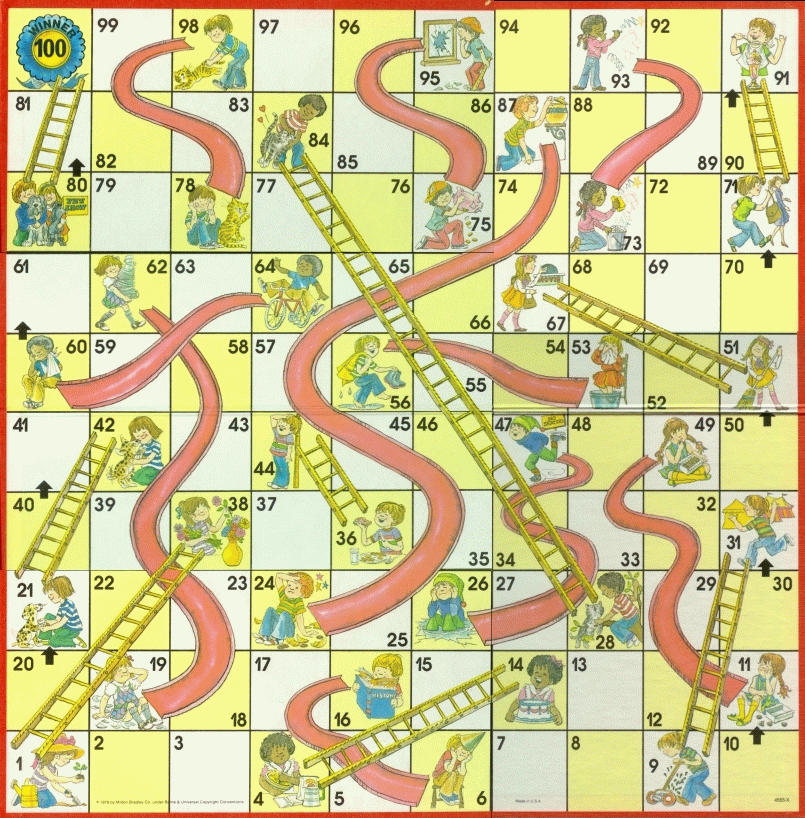
Find the best strategy in a multi-player board game​

  • Variant of Chutes & Ladders​
    • Player decides whether or not to take a chute or ladder​
  • Extremely large Solution Space
    • Impossible to simply try all options
Chutes and Ladders 3.gif

Other Model Types

  • Shortest Path Algorithm
    • Guarantees shortest path but not necessarily best strategy
  • Mixed-Integer Programming Model
    • Requires a mathematical fitness function (can't use a simulation)
  • Neural Network
    • Requires a very large training data corpus

Genetic Algorithms

Find Solutions by Simulating Darwinian Evolution​

  • Each candidate solution is defined by its properties (chromosomes)​
  • A fitness function is used to determine which solutions "survive"
    • A simulation may be used as the fitness function
  • Surviving solutions may mutate and evolve other solutions​

Optimality is Never Guaranteed

  • Optimal solution may never be found
    • i.e. If a optimality requires a large combination of elements
  • Optimum may be found but not recognized
    • If conditions make that solution non-optimal at that moment
      • i.e. If a key feature is not used during the simulation
    • Minimize the liklihood by increasing simulation size

Determine Our Game Strategy

  • We need a strategy that will tell us where we

    should move to next, given:

    • Our location on the board
    • The result of our spin
    • The location of our opponents (opt)
    • Our player number (opt)
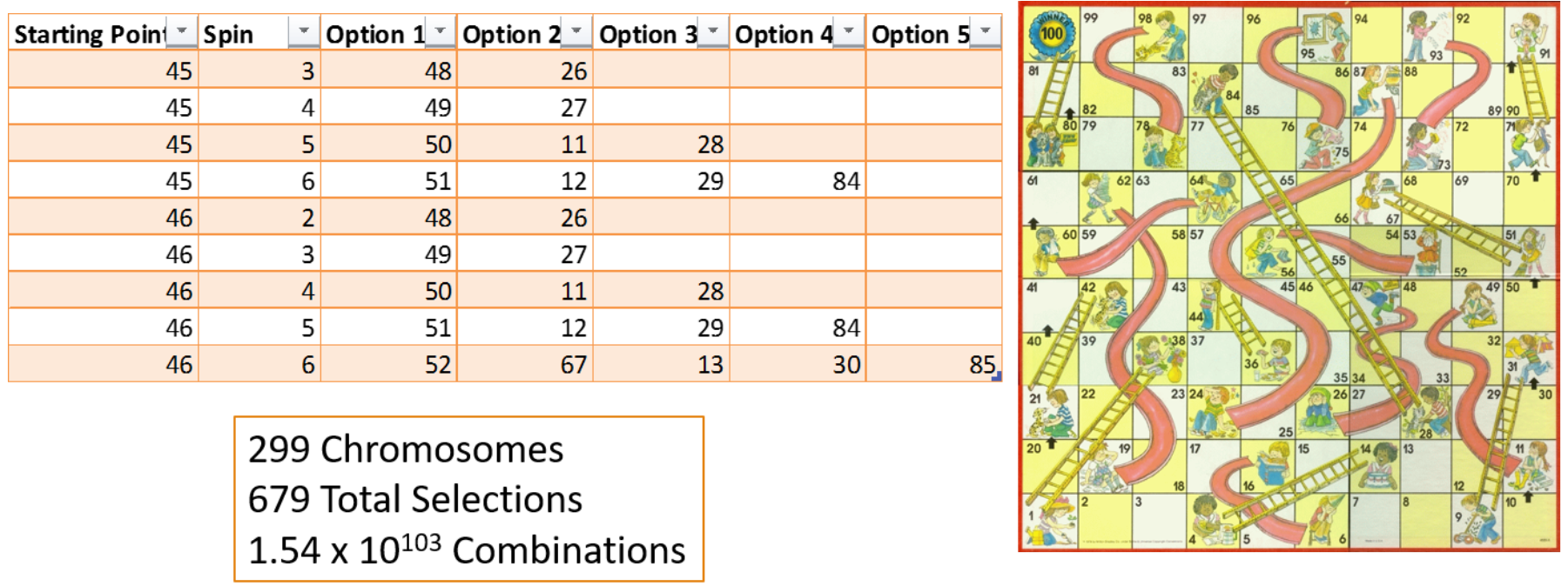
  • Example: If we are on square 45 and spin a:

    • 1 - 46 (no choice)
    • 2 - 47 (no choice)
    • 3 - 48 or 26
    • 4 - 49 or 27
    • 5 - 50, 11 or 28
    • 6 - 51, 12, 29 or 84
Chutes and Ladders 3.gif

Step 1 - Define DNA

  • A chromosome represents all of the possible decisions that can be made

  • Each gene represents a decision

    • Ideally a gene fully describes a single game state
    • If no decision is possible for a state, there is no gene for that state
  • An allele is an option for that decision

    • If there are 3 options for a given state there will be 3 possible alleles for that gene

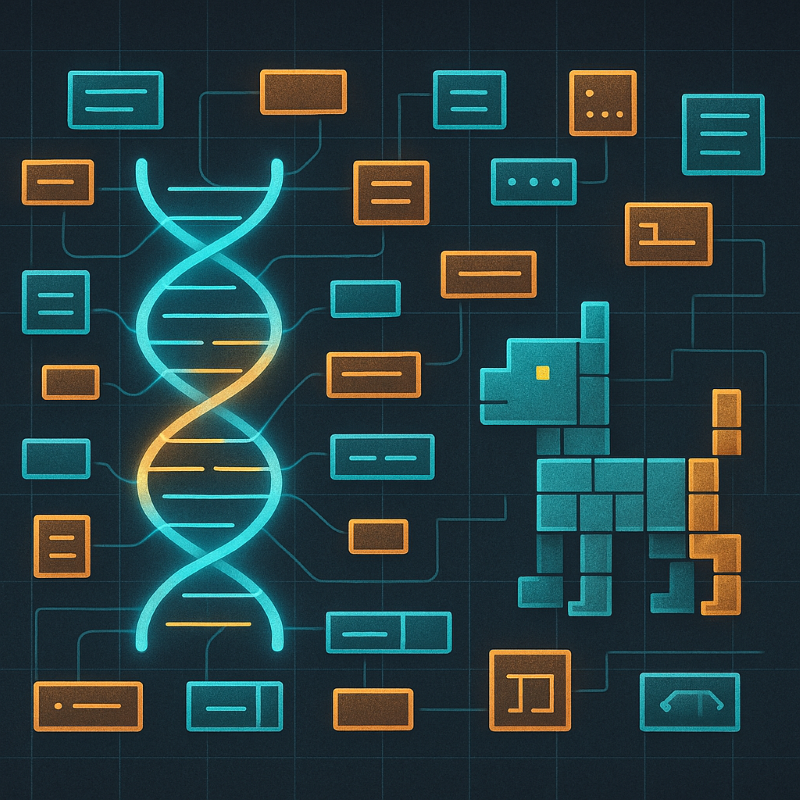
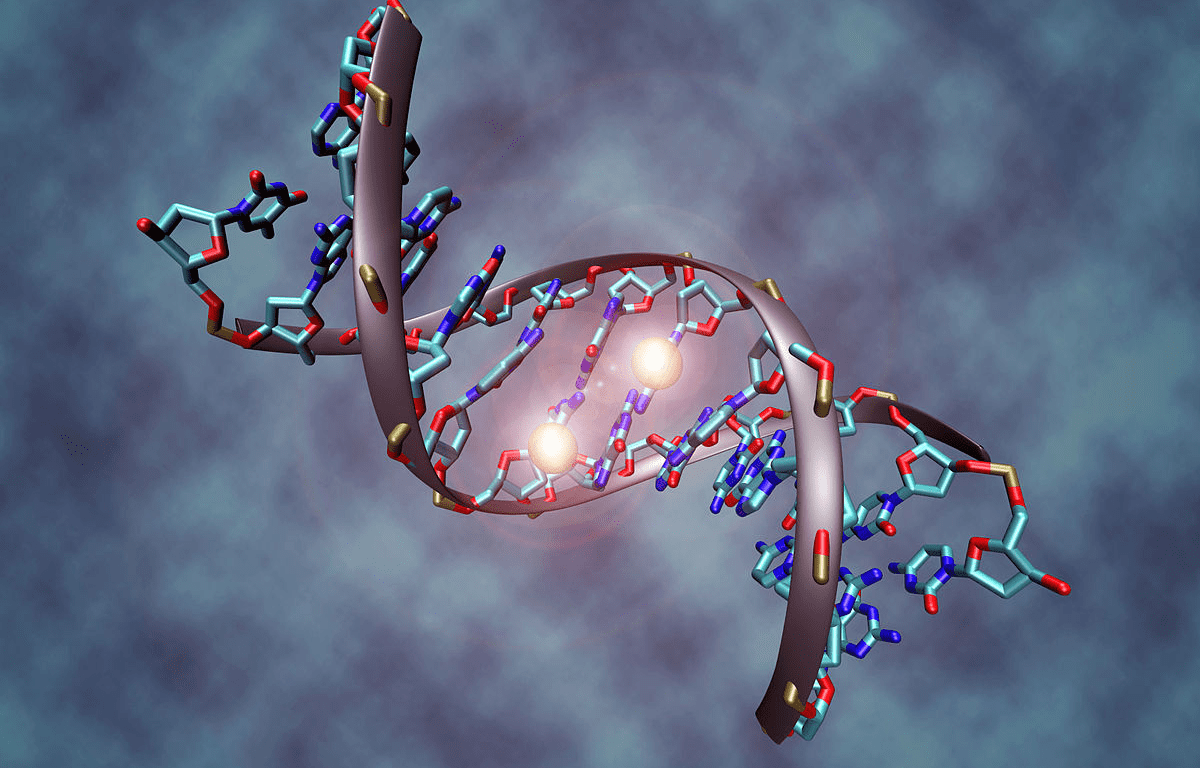
DNA of Chutes & Ladders

DNA.png

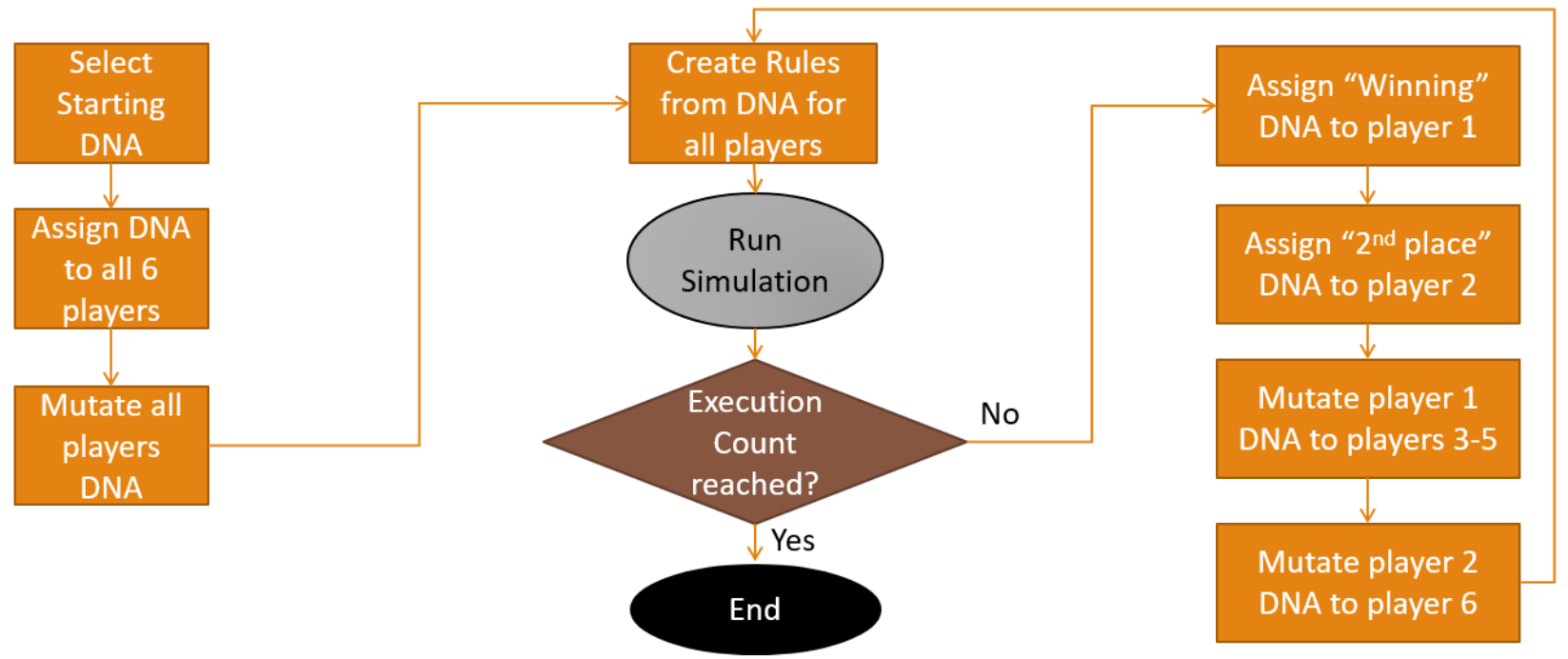
Step 2 - Setup Parameters

  • Simulations per Generation
    • Controls how often the solutions evolve
    • More simulations make it more likely the best solution will survive
  • Generation Count
    • Controls simulation length
    • Optionally look for convergence
      • When does improvement stop?
      • When do significant changes stop during crossover?
  • Error (misspelling) rate
    • Controls how frequently genes change allele's during the evolutionary process
    • Higher rates cause greater variations from generation to generation
  • Selection strategy
    • Defines which solutions survive and mutate
      • Survive intact - Remain unchanged to next generation
      • Survive mutated - Modified versions survive to next generations
      • Survive recombined - Crossover between two solutions survives

Genetic Algorithm

Genetic Algorithm.png

Step 3 - Run the Simulations

DNA.png
 

Options for Experimentation

  • Implement in your preferred language

    • C# implementation is on GitHub
  • Augment to include what place the player is in

    • i.e. Might make different decisions if started 1st vs 6th
  • Augment to include opponent locations

    • i.e. Might make different decisions if opponents are close to the end
  • Define the DNA of another game

    • Recommendation - stick with simpler games to start
    • Avoid games like chess with massive complexity

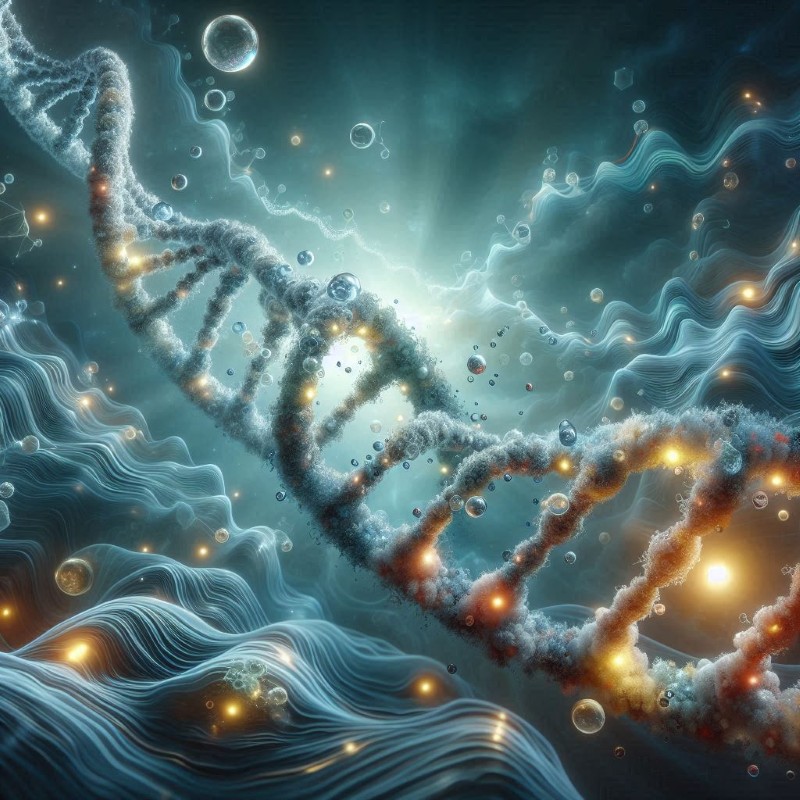
Problem 2 - Semantic Distance

semantic-dna-surreal 800x800.jpeg

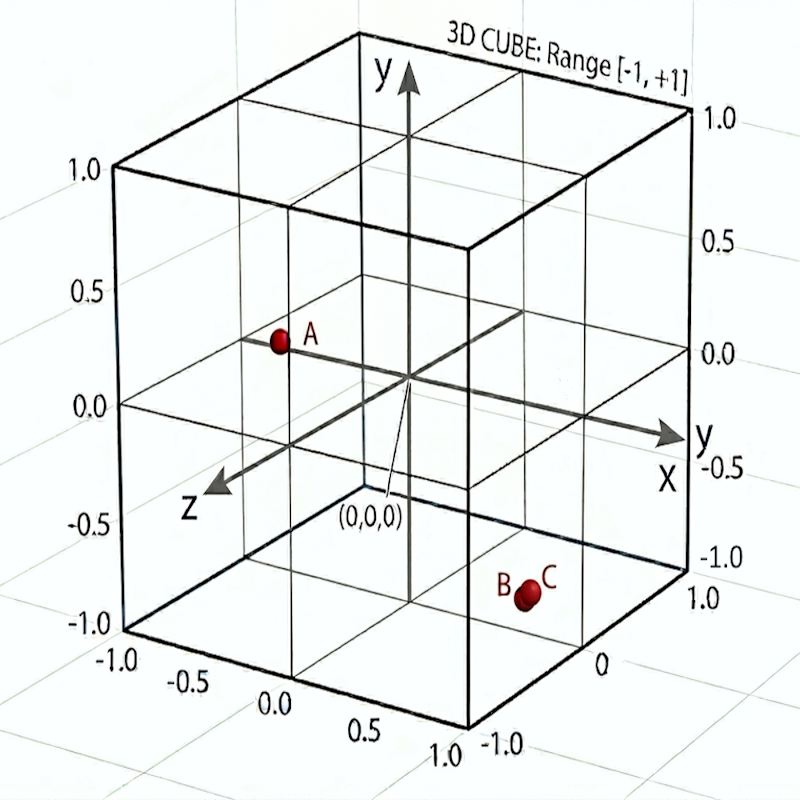
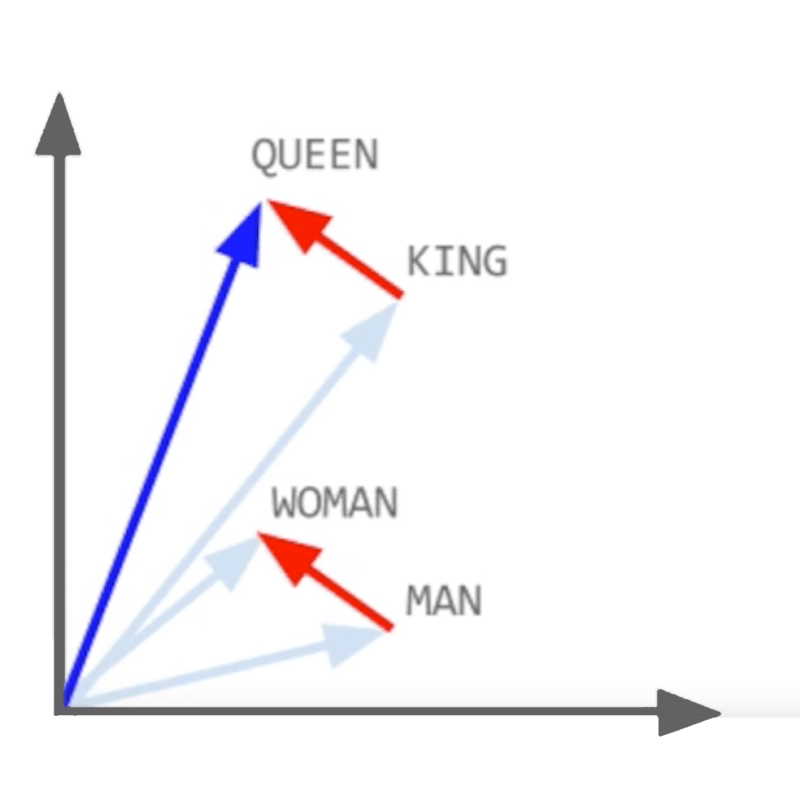
Embeddings

  • A point in multi-dimensional space
  • Mathematical representation of a word or phrase
  • Encode both semantic and contextual information

  • Model: text-embedding-ada-002
  • Vectors normalized to unit length
  • Use 1536 dimensions
Embeddings - Cosmic Desert 800x800.jpg

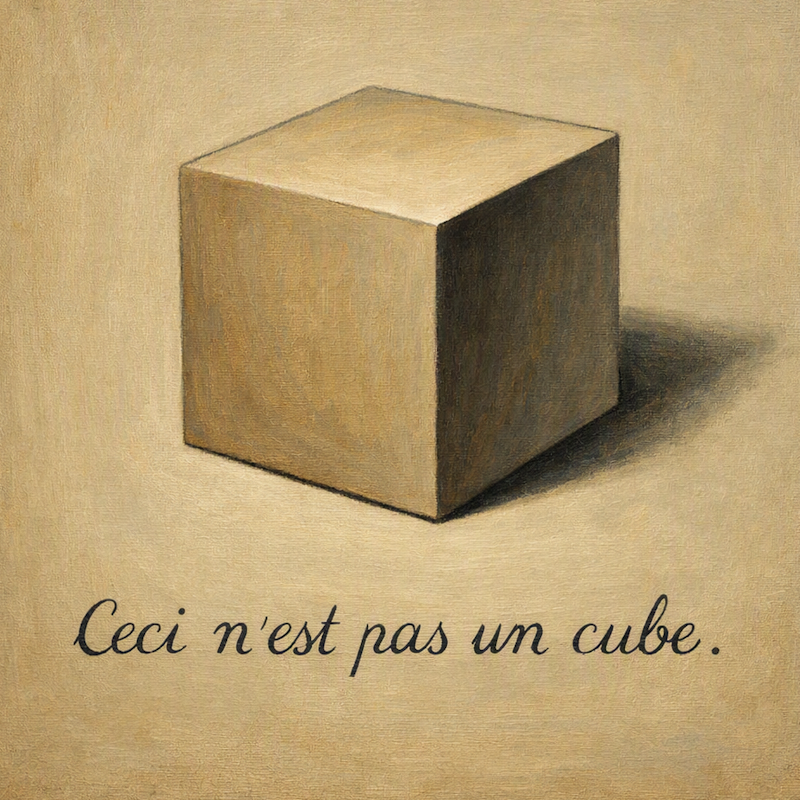
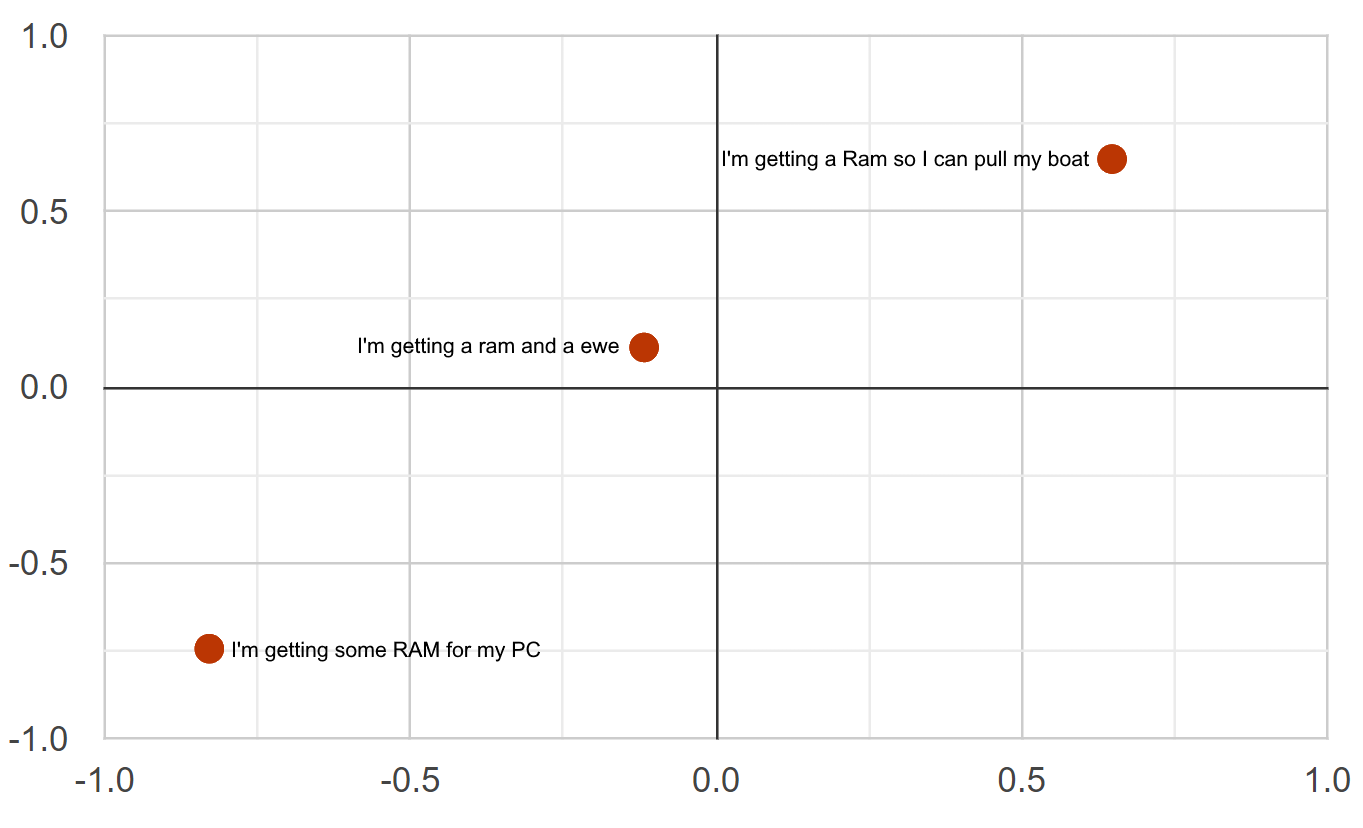
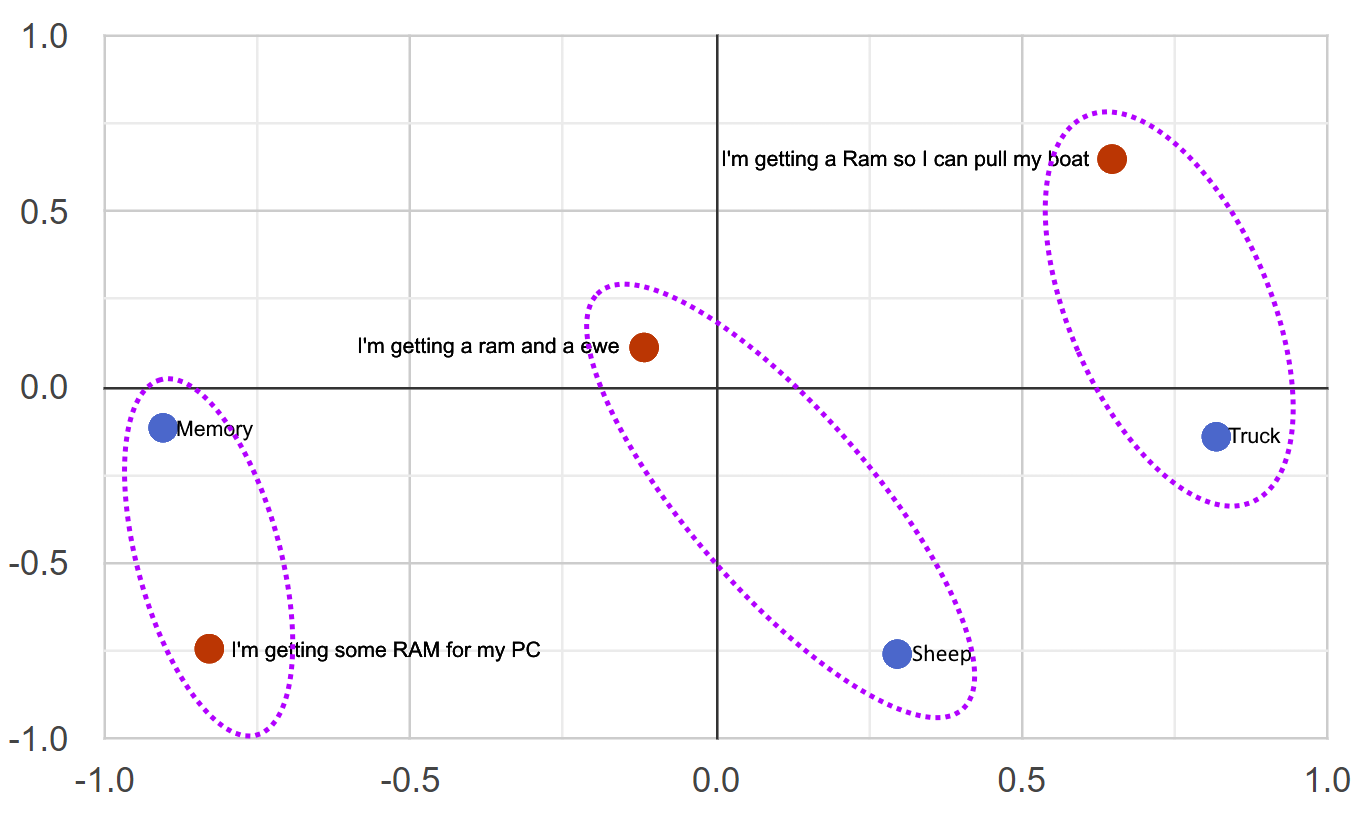
3-D Space Projected into 2-D

Necker_cube_with_background.png
  Ram - Just Statements.png
  Ram - With Clusters.png

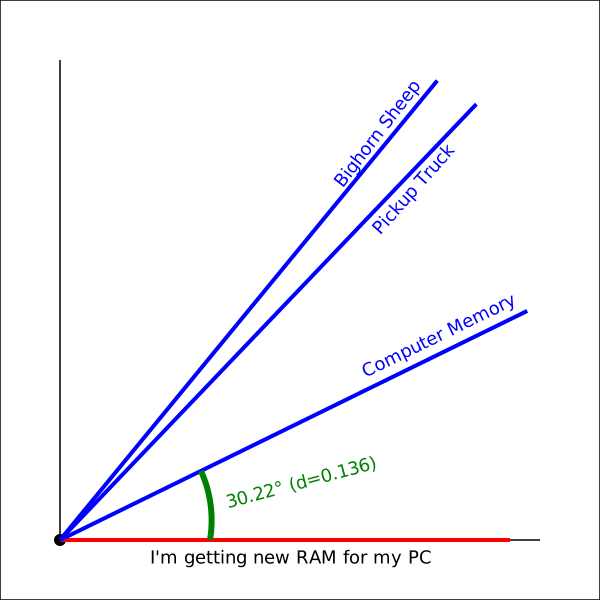
Cosine Similarity & Distance

Relate vectors based on the angle between them

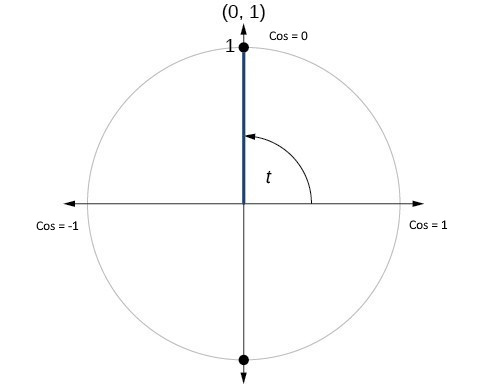
  • Cosine Similarity ranges from -1 to 1, where:

    • +1 indicates that the vectors represent similar semantics & context
    • 0 indicates that the vectors are orthogonal (no similarity)
    • -1 indicates that the vectors have opposing semantics & context
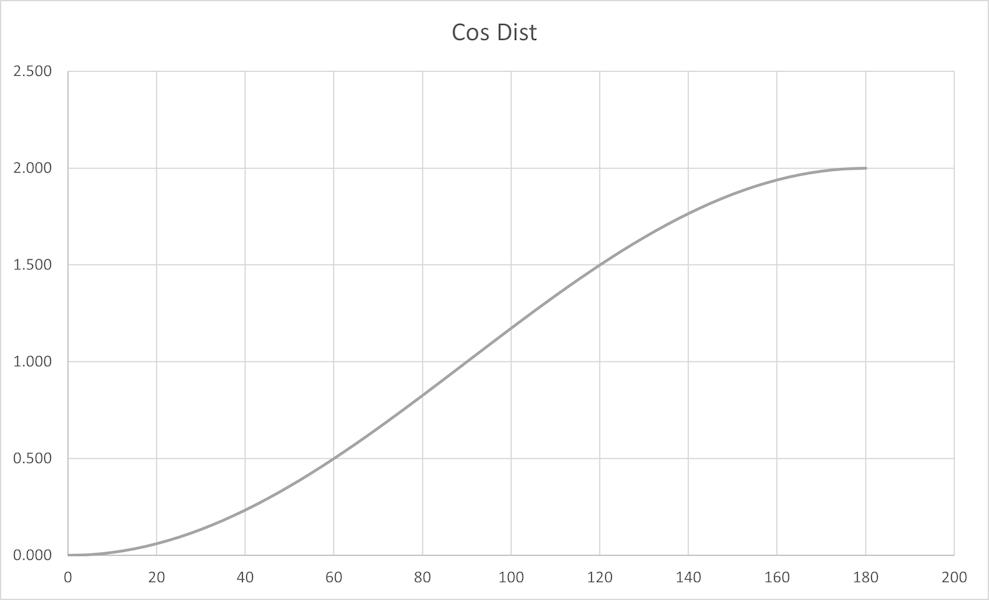
  • Cosine Distance is defined as 1 - cosine similarity where:

    • 0 = Synonymous
    • 1 = Orthogonal
    • 2 = Antonymous

Note: For normalized vectors, cosine similarity is the same as the dot-product

Cosine Unit Circle - Enhanced.jpg

Cosine Distance

Cosine Distance 989x600.png

Cosine Distance

Angles2.svg

Embedding Distance

Feature Example
Synonym "Happy" is closer to "Joyful" than to "Sad"
Language "The Queen" is very close to "La Reina"
Idiom "He kicked the bucket" is closer to "He died" than to "He kicked the ball"
Sarcasm "Well, look who's on time" is closer to "Actually Late" than "Actually Early"
Homonym "Bark" (dog sound) is closer to "Howl" than to "Bark" (tree layer)
Collocation "Fast food" is closer to "Junk food" than to "Fast car"
Proverb "The early bird catches the worm" is closer to "Success comes to those who prepare well and put in effort" than to "A bird in the hand is worth two in the bush"
Metaphor "Time is money" is closer to "Don't waste your time" than to "Time flies"
Simile "He is as brave as a lion" is closer to "He is very courageous" than to "He is a lion"

Modeling Exercise

Design a system to find words/phrases that are far apart (semantically different) in the embedding space?

  • Assumptions

    • No db of embeddings available to search
    • Limited understanding of the features of the embedding space
      • i.e. changing language changes nearly every dimension
  • What type of models might work?

    • Can we do it logically?
    • Can we brute-force it?
    • Are there hybrid approaches?
  • What are the features of each model?

  • How do we execute the model(s)?

Possible Genes

  • Categorical

    • Part of Speech (noun, verb, etc)
    • Register (formal, slang, technical, etc)
    • Morphology (root, compound, phrase)
    • Animacy (inanimate, animate, agentic, collaborative)
    • Scientific Discipline (biology, physical, life/health, etc)
  • Continuous

    • Polarity (negative -> positive)
    • Idiomaticity (literal -> idiomatic)
    • Concreteness (abstract -> concrete)
  • Other Options

    • Language

Mapping Strategies

We need to find what should change in order to identify a word distant from the current one

  • Part of Speech: Noun -> Adverb
  • Discipline: Software Engineering -> Philosophy
  • Polarity: Neutral -> Highly Positive

Linguistic Agent - System Prompt

You are a simulation of a great linguist. You classify words/phrases within the following categories:

  • Part of Speech (noun, verb, etc)
  • Register (formal, slang, technical, etc)
  • Scientific Discipline (biology, physical, life/health, etc)
  • Morphology (root, compound, phrase)
  • Animacy (inanimate, animate, agentic, collaborative)
  • Polarity (highly negative, negative, neutral, positive, highly positive)
  • Idiomaticity (highly literal, literal, idiomatic, highly idiomatic)
  • Concreteness (highly abstract, abstract, concrete, highly concrete)

Your job is to identify words/phrases that meet the requested characteristics. You respond only with the requested word or phrase in lower case.

Linguistic Agent - User Prompt

Give me a word or phrase with the following characteristics:

  • Primary part of speech is verb
  • Register is technical
  • Morphology is phrase
  • Animacy is collaborative
  • Scientific Discipline is biology
  • Polarity is highly negative
  • Idiomaticity idiomatic
  • Concreteness highly concrete

and is not in the following list: "prime genius", "engineer a cooperative symbiosis".

Be sure to only respond with the selected word or phrase, no ceremony.

What Else Can We Do with Our Linguistic Genome?

Once we can encode the traits of a word/phrase/idea, what other fitness functions could we apply?

  • The DNA defines the traits of the specific organism (candidate)
  • The Fitness Function defines the direction of evolution

Linguistic Genome Experiments

  • Phonetics - Alliteration, Rhyme, or Assonance
  • Rhythm - Punchy words or flowing patterns
  • Imagery - Reward evocations of vivid emotional imagery
  • Narrative - How “heroic”, “mysterious”, or “pastoral”
  • Temporal - Prefer archaic, modern, or futuristic language
  • Novelty - Reward surprise or pattern-breaking
  • Constraint - Avoid forbidden categories or styles
  • Information-Density - Pack more meaning per syllable
Darwinian Fitness - 800x800.jpg

Genetic Systems

Genetic Systems 1024x430.png

Commonalities

We discussed 2 problems:

  • Game strategy - what's the best move given game state?
  • Semantic Distance - what word should I test next?

What do they have in common? What makes them good candidates for genetic algorithms?

Summary

  • Genetic Algorithms "Learn" by simulating Darwinian Evolution
  • The "DNA" represents the decisions that can be made
    • One chromosome per condition (game state)
    • One gene per option (choices from a state)
  • Several parameters control how solutions evolve
    • Simulations per Generation - how often the solutions change
      • Fewer simulations make it more likely a less-fit solution will survive over a more-fit solution
    • Error (misspelling) rate - how often each chromosome changes between generations
      • Higher rates cause greater variations from generation to generation
    • Selection strategy - Which solutions survive and mutate
      • Survive intact - Remain unchanged to next generation
      • Survive mutated - Modified versions survive to next generations
      • Survive recombined - Crossover between two solutions survives

Resources

SolutionsThatEvolve-Session-QRCode-450x450.png
 

Appendix

Simulates A Rational Actor

Attempts to make the best possible decision​ based on the model and the data

  • Model - Our description of the problem
  • Data - Our understanding of the state of the domain
A Rational Actor 800x800.jpeg

Models are the Blueprint

The success of a problem-solving algorithm is often determined before the algorithm even runs -- by how the problem is modeled

Models are the Blueprint 800x800.jpg

Modeling

  • Modeling defines the problem space
    • What’s included & what’s ignored
    • Poor models lead to irrelevant solutions
  • Modeling shapes the solution strategy
    • Logical models » OOP or Rules Engines
    • Graph models » traversal algorithms
    • Constraint models » LP or MIP
    • Probabilistic models » Neural/Bayesian Networks
  • Modeling can determine tractability
    • Some formulations make problems NP-hard
    • Others reveal polynomial-time solutions
    • Examples
      • Conference Scheduling with LP vs MIP
      • Traveling Salesman with OOP